How AWCuPreM is turning World Cup drama into mathematics, mentorship, and sports policy
By Nashon J. Adero | FIFA World Cup 2026 Thought Leadership Series
From Russia 2018 to North America 2026, iterative recalibration, systems thinking and evidence-informed modelling present key lessons for reshaping football analytics, coaching, and the future of sports education in Africa.
The quiet equation behind the World Cup match predictions
The journey of AWCuPreM can be traced back to the 2018 FIFA World Cup, held in Russia, when the model’s conceptual foundations were first tested and calibrated. During my advanced studies in Germany, the model emerged as a personal coping strategy amidst the intellectual demands of research. Yet it quickly evolved into something much bigger: a crowd-puller that brought together international students to experience the world’s biggest sporting spectacle through the dispassionate lens of applied mathematics. Football ceased to be merely a game; it became a real-time experiment in system dynamics, uncertainty, and decision support. What began as an intellectual holiday from demanding research evolved into an applied mathematics laboratory, where football became the language through which probability, systems thinking, uncertainty and decision science could be experienced beyond the classroom. Looking back, those informal discussions marked the beginning of a modelling journey that continues to evolve today. Subsequent refinements during the 2022 FIFA World Cup, CHAN 2024 analyses, and now the 2026 FIFA World Cup have progressively strengthened its theoretical foundation, transforming it from a prediction framework into a systems-based football decision-support model.
From spectacle to systems thinking
Football is often described as a game of chance. The World Cup seems to support that claim: a deflection changes destiny, a goalkeeper stretches history, a penalty reshapes national memory, and an underdog suddenly becomes a continent’s proverb. Yet the deeper lesson is not that football is random. The lesson is that football is a complex system, and complex systems reward those who can narrow uncertainty without pretending to abolish it.
That is where Adero’s World Cup Prediction Model (AWCuPreM) finds its intellectual home. It is not a gambling tool, a mystical oracle, or a black-box machine. It is a systems-thinking, decision-support model designed to ask a better question than “Who is stronger?” The better question is: what conditions must change for a team to prevail?
That question matters now as the FIFA World Cup 2026 enters the Round of 16. The Group Stage and Round of 32 have been a laboratory. They have taught us that the best model is not the one that refuses to change; it is the one that learns responsibly from evidence.
The provenance: made, tested, tasted, and recalibrated
The AWCuPreM journey did not begin in 2026. The model was conceptualised and calibrated in 2018, then applied to the France-Croatia final, where it gave France a slim mean marginal advantage of 1.9%. In 2022, the model moved from a less public experiment to a wider educational and mentorship platform at Taita Taveta University and through Impact Borderless Digital. The DIGI-FACE article on “Testing and tasting the sweetness of World Cup at Taita Taveta University with prediction models” documents this provenance and the educational mission behind it.
The 2022 World Cup became a serious recalibration phase. AWCuPreM was applied to 40 matches, including 24 group-stage matches. It reported a 70% success rate across those 24 group matches, 80% after excluding four major surprise outcomes, 100% in the knockout stages, 90% in the quarterfinals, 100% in the semifinals, and 100% in the final. Most significantly, it projected Argentina as better placed than France in the final by a razor-thin 0.5% mean marginal advantage, consistent with a draw in normal time and a scenario-sensitive pathway to Argentina’s eventual triumph.
Later, the Impact Borderless Digital (IBD) posts extended the same modelling philosophy to African competitions, including CHAN modelling under ACPreMo, and then back into the 2026 World Cup under the matured AWCuPreM lens. The journey is therefore not a one-off burst of tournament excitement. It is a continuous recalibration journey: Russia 2018, Kenya 2022, African football dynamics through CHAN, and now North America 2026.
Why AWCuPreM is different
Many football models lean heavily on historical results, rankings, market values, and regression-style projections. These are useful, but they can become enslaved by history. AWCuPreM appreciates history without surrendering to it. It treats current team architecture, match context, psychological dynamics, and scenario-sensitive uncertainty as mathematically meaningful.
The model works through nine variables: Team coherence, Score drive, Tenacity gradient, Honed execution excellence, Tactical inventiveness, Mentality premium, Serendipity stroke, Resistive nucleus, and Climate and venue fit. These are not merely labels. They represent a grey-box modelling philosophy: enough mathematical structure to be disciplined, enough contextual sensitivity to remain realistic, and enough explanatory power to mentor young people into seeing mathematics as a living language.
The refined AWCuPreM hierarchy: Redefining the science of knockout success
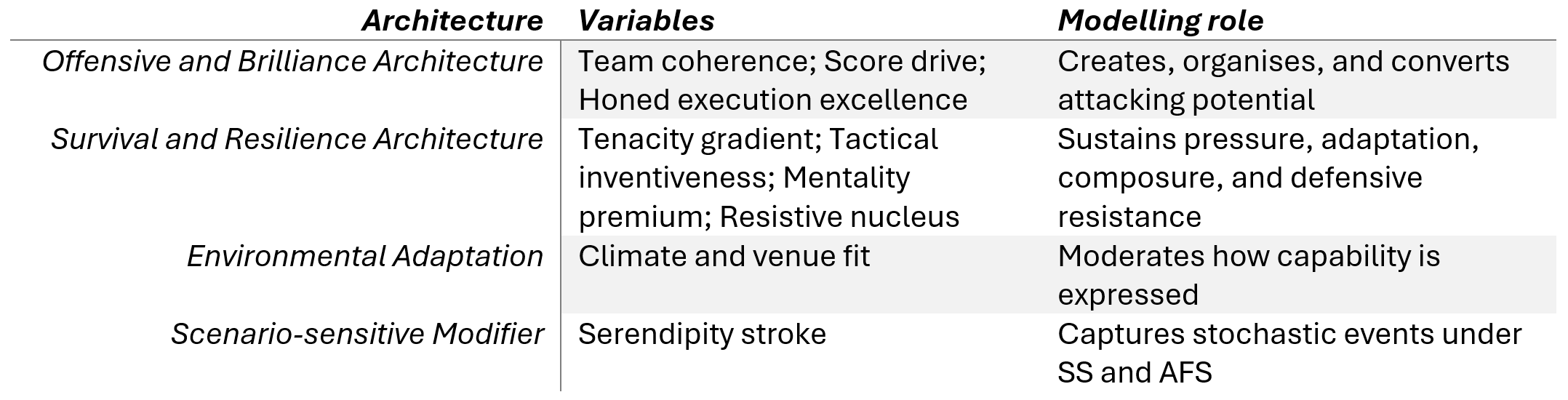
The 2026 World Cup has now sharpened the model into a cleaner hierarchy. Team coherence stands as the core structural capability. Six variables act as intervening or mediating variables: Score drive, Tenacity gradient, Honed execution excellence, Tactical inventiveness, Mentality premium, and Resistive nucleus. Climate and venue moderates how capability is expressed under environmental conditions. Serendipity stroke acts as a scenario-sensitive moderator, especially under the Surprising Scenario (SS) and Augmented Favour Scenario (AFS).
The AWCuPreM causal architecture
A systems-thinking approach was engaged to arrive at the following broad classification of variables, informed by a mental map of causal loop diagrams. Fellow members of the System Dynamics Society will readily recognise this way of thinking. AWCuPreM draws inspiration from the systems-thinking tradition pioneered by Jay Forrester and advanced by distinguished scholars such as Barry Richmond, John Sterman, and Donella Meadows. Their collective work reminds us that complex systems are rarely understood by examining isolated events; rather, they are explained through the dynamic interactions, feedback loops, delays, reinforcing and balancing mechanisms that shape behaviour over time. AWCuPreM seeks to apply this same systems perspective to football, viewing a match not merely as ninety minutes of competition, but as a complex adaptive system in which interacting capabilities, environmental conditions, and scenario-sensitive events jointly determine the eventual outcome.
The goalkeeper is not a detail; he is a system amplifier
The most important Round of 32 lesson is the goalkeeper. AWCuPreM now explicitly treats goalkeeper quality as part of the Resistive Nucleus, together with defensive compactness, centre-back stability, recovery discipline, and set-piece resistance. A goalkeeper can elevate an otherwise modest defensive structure into a knockout wall.
Paraguay’s elimination of Germany and Cape Verde’s ability to push Argentina into extra time made this lesson unavoidable. A team may be inferior in total capability index, yet remain knockout-dangerous if its Resistive Nucleus is goalkeeper-amplified. Exceptional shot-stopping, command of the area, penalty resistance, and late-game composure are not footnotes. They are structural assets.
This is the new AWCuPreM theorem: knockout football is won not only by the strongest Offensive and Brilliance Architecture, but also by a goalkeeper-amplified Resistive Nucleus that keeps the contest alive long enough for Survival and Resilience Architecture, and where applicable Serendipity Stroke, to overturn a marginal capability deficit.
What Round of 32 taught us
The Round of 32 confirmed three lessons. First, margins matter. Colombia’s 1-0 win over Ghana confirmed the AWCuPreM reading of a narrow Colombia advantage capable of translating into a one-goal victory. Second, scenario shocks matter. Argentina’s 3-2 extra-time win over Cape Verde confirmed that even elite teams can be dragged away from Business as Usual when the underdog activates survival variables. Third, goalkeepers and penalties matter. Egypt’s progression over Australia after a 1-1 draw and penalties reinforced the need to give goalkeeper quality more explicit weight inside the Resistive Nucleus.
The model also learned from Paraguay. Eliminating Germany is not just an upset; it is a high-value evidence point. Paraguay therefore deserves upward adjustment in Tenacity gradient, Mentality premium, Serendipity stroke, and Resistive nucleus. A model that refuses such recalibration is no longer modelling; it is merely defending its ego.
Beginning of Round 16: Free coaches’ advice from the AWCuPreM lens
For the beginning of Round of 16, Canada face Morocco with Morocco carrying the stronger architecture. Canada cannot win by trying to out-Morocco Morocco technically. Canada must keep the match scoreless for at least the first hour, raise the Resistive Nucleus through goalkeeper excellence and compact defending, sustain Tenacity gradient for 90 to 120 minutes, and convert transitional moments before Morocco reorganises.
Below are extracts from the mathematical model, mirroring with precision the three scenarios to expect as the matches pitting Morocco against Canada, and France against Paraguay, open:
“AWCuPreM simulates the Canada–Morocco knockout duel as having a capability index differential that gives Morocco a good Mean Marginal Advantage (MMA) of 3.6% over Canada in the Business as Usual (BAU) scenario. This mathematical advantage translates into a 2-goal difference in favour of Morocco in normal match time. Even in the Surprising Scenario (SS), serendipity can only propel Canada to force a draw, and hence extra time, then penalties if they sustain tenacity gradient and goalkeeping excellence. The Augmented Favour Scenario (AFS) spells Canada’s worst fate, where serendipity augments Morocco’s superior offensive and brilliance architecture to open wide a wild (3-4)-goal difference. Now, watch and enjoy mathematically, thanks to the IBD modelling and youth mentorship series (#IBDSeries).”
Paraguay face France with France still favoured, but the danger is real. Paraguay must avoid an open game. An open game feeds France’s Offensive and Brilliance Architecture. A controlled, physical, patient contest feeds Paraguay’s Survival and Resilience Architecture. Paraguay’s coaching brief is simple: repeat the goalkeeper-backed discipline shown against Germany, deny France central isolation channels, and convert one or two rare opportunities with Honed execution excellence.
“AWCuPreM simulates the France–Paraguay knockout duel as having a capability index differential that gives France a Mean Marginal Advantage (MMA) of 2.9% over Paraguay in the Business as Usual (BAU) scenario. This mathematical advantage translates into a sure 1-goal difference in favour of France in normal match time, and a lucky graduation into a 2-goal difference. Even in the Surprising Scenario (SS), serendipity can only propel Paraguay to force a draw, and a very lucky 1-goal difference, if at all, with extra time and penalties considered if they sustain tenacity gradient, mentality, and goalkeeping excellence. The Augmented Favour Scenario (AFS) spells Paraguay’s worst fate, where serendipity augments France’s superior offensive and brilliance architecture to open wide a wild (3-4)-goal difference. Now, watch and enjoy mathematically, thanks to the IBD modelling and youth mentorship series (#IBDSeries).”
For subsequent contenders, the advice generalises. Underdogs should stop asking whether they are stronger. They should ask which variable must be raised to survive long enough to strike. Favourites should stop assuming superiority will express itself automatically. They must protect Team coherence, avoid psychological drift, and prevent the underdog’s goalkeeper from becoming the match’s hidden professor.
The 86th-minute effect is not a curse; it is a systems failure
African football has its painful folklore: the late crash, the 86th-minute heartbreak, the match that looked safe until it suddenly was not. Supporters may call it a curse. AWCuPreM calls it a systems failure. Late collapse is often the decay of Mentality premium, the loosening of Team coherence, the fatigue of the Resistive Nucleus, and the failure of Tactical inventiveness to manage the final emotional economy of the match.
The cure is not superstition. It is modelling, psychology, game management, and evidence-informed coaching. African teams need closing-stage protocols: when to press, when to pause, when to commit a tactical foul, when to slow the rhythm, when to change shape, and when the goalkeeper must become the organiser of national calm.
Can football restore the dignity of the mathematics teacher? From “Hapa ni wapi, mwalimu wa maths?” to “Where is the modeller?”
The World Cup can rescue the dignity of the mathematics teacher. The caricature “Hapa ni wapi, mwalimu wa maths?” reduces the mathematics teacher to a comic figure of social awkwardness. But modern football reveals a different truth. Mathematics is the grammar behind probability, xG, scheduling, ranking, tactical space, injury risk, and performance analytics.
Under Kenya’s Competency-Based Education reforms, this is a golden opportunity. Sports analytics can popularise mathematics, AI, statistics, systems thinking, data science, and performance science among young people. The football pitch can become a classroom without walls, and the modeller can become a mentor without a chalkboard.
A policy challenge for Africa: When mathematics coaches football
Elite football is no longer just boots, passion, and prayers. It is also data, psychology, physiology, modelling, and decision-support systems. African football federations and ministries responsible for sport should establish coaching advisory panels that include coaches, sports scientists, psychologists, physiologists, statisticians, AI specialists, GIS and systems modellers, and mathematical modellers.
This is not a call to replace coaches. It is a call to strengthen them. The coach sees the match. The modeller sees the hidden architecture that shapes it. Together, they can narrow uncertainty, prepare better scenarios, and build resilient teams. The academy must be taken seriously, not as a ceremonial guest at sports events, but as a strategic partner in talent pipeline development.
Conclusion
Football is increasingly won not only on the pitch, but also in the model. The ball still rolls, the crowd still roars, and serendipity still smiles. But the nations that will rise are those that can combine talent with tactics, passion with parameters, and coaching with credible modelling. The next competitive advantage may not be the loudest chant in the stadium. It may be the quiet equation behind the thrilling tournament, and our good mathematical modellers, our systems thinkers and almost-forgotten researchers, are the powerhouse of this golden talent that must henceforth be part of the coaching and sports advisory committees if African teams are serious about transforming the “86th-Minute Effect” into an unassailable mathematical advantage.
Selected references and further reading
Adero, N. (2022, December 22). Testing and tasting the sweetness of World Cup at Taita Taveta University with prediction models. DIGI-FACE Platform. https://www.digiface.org/testing-and-tasting-the-sweetness-of-world-cup-at-taita-taveta-university-with-prediction-models/
Adero, N. (2026). AWCuPreM 2026 World Cup modelling notes and live recalibration series. Impact Borderless Digital (IBD). https://impactborderlesdigital.com
Fédération Internationale de Football Association (2018). 2018 FIFA World Cup Russia. FIFA. https://www.fifa.com
Fédération Internationale de Football Association (2022). FIFA World Cup Qatar 2022. FIFA. https://www.fifa.com
Fédération Internationale de Football Association (2026). FIFA World Cup 2026 match centre. FIFA. https://www.fifa.com
Sumpter, D. (2016). Soccermatics: Mathematical adventures in the beautiful game. Bloomsbury Sigma.
You must be logged in to rate posts.