DIGI-FACE credentials, expressed as digital badges, micro-credentials, and short learning programmes (SLPs), are designed to support flexible, skills-focused and academically rigorous learning for postgraduate students, academics, researchers, and university professionals.
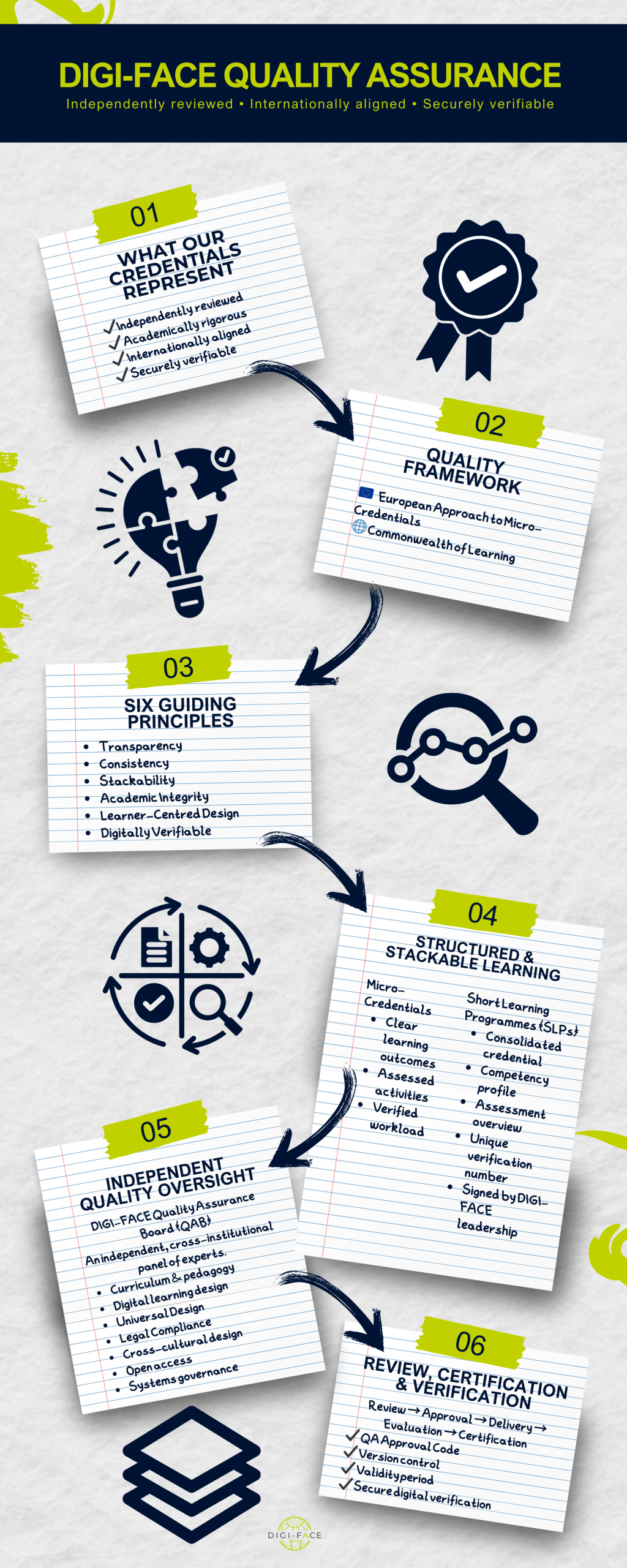
The DIGI-FACE quality framework aligns with the UNESCO Guidelines for Micro-Credentials, the European Approach to Micro-Credentials, and the Commonwealth of Learning framework.
DIGI-FACE credentials are underpinned by six guiding principles: transparency, consistency, stackability, academic integrity, learner-centred design, and digital verifiability. These principles inform the design, delivery, assessment, and certification of every micro-credential and SLP offered on the platform.
Each DIGI-FACE micro-credential or Short Learning Programme (SLP) represents a clearly defined learning unit with articulated learning outcomes, assessed activities, and a verified workload. Micro-credential badges may be combined to form SLPs, enabling participants to build coherent, skills-based learning pathways.
A DIGI-FACE certificate confirms that the completed learning has been reviewed and quality-assured in accordance with recognised international standards for micro-credentials and short learning programmes.
Every micro-credential and SLP is developed through a transparent approval process designed to ensure academic integrity, professional relevance, and international alignment.
Each SLP certificate specifies the content, learning outcomes achieved, and a unique verification number. Certificates are formally endorsed by DIGI-FACE leadership, ensuring institutional legitimacy and traceability.
DIGI-FACE certificates therefore represent learning that institutions, employers, and partner organisations can trust. They signal not only completion but verified quality and standards compliance.
Quality assurance is governed by the DIGI-FACE Quality Assurance Board, a cross-institutional panel of experts drawn from partner universities in Africa and Europe. The Board includes senior academics and specialists in curriculum and pedagogy, digital learning design, accessibility, intercultural content design, legal compliance, and systems governance.
Members represent Kehl University of Applied Sciences (Germany), Nelson Mandela University (South Africa), the University of Oldenburg (Germany), Uganda Management Institute (Uganda), and the Université Protestante du Congo (Democratic Republic of the Congo).
The Board approves all DIGI-FACE micro-credentials and Short Learning Programmes, validates assessment strategies, and ensures alignment with international standards. Each DIGI-FACE module undergoes formal review prior to delivery and is subject to post-delivery evaluation informed by learner feedback. Approved modules receive a Quality Assurance Approval Code, documented version control, and a defined validity period.
To ensure consistency and academic rigour, the Quality Assurance Board has developed a structured set of mandatory and optional criteria against which each course is assessed. Please see General information about the Module that is required for initial consideration and the Quality Assessment of Online Modules – Checklist .
This Quality Assessment of Online Modules checklist includes general information about the module, pedagogical design criteria, accessibility considerations, and assessment standards. These criteria provide a clear framework for systematic evaluation while simultaneously serving as design guidance for course developers. In this way, quality assurance functions not only as oversight but also as developmental support for high-quality online module creation.
In addition to overseeing teaching and learning provision, the Board has established requirements and quality criteria for publications hosted in the ‘Publication Area’ of the DIGI-FACE platform. It has implemented processes to ensure accurate depiction, attribution, and citation of published materials, thereby safeguarding scholarly standards.
All DIGI-FACE certificates and digital badges are securely verifiable through the DIGI-FACE verification portal, allowing employers and institutions to confirm authenticity and scope. Certificates are formally issued upon successful completion and generated as secure PDF documents within the DIGI-FACE Moodle environment.
Certificate records are stored within Moodle’s protected file storage system and database infrastructure, secured through institutional access controls and backup procedures. Each certificate carries a unique verification number and is independently verifiable.
Through this structured, transparent, and internationally aligned quality assurance system, DIGI-FACE ensures that its credentials reflect rigorous academic standards and credible professional recognition.

DIGI-FACE – Digital Initative for African Centres of Excellence represented by:
University of Applied Sciences Kehl
Kehl Institute of Applied Research (KIAF)
Projects International Cooperation and Development
Kinzigallee 1, D- 77694 Kehl
+49 7851 894143
https://www.hs-kehl.de/
Contact: digiface[at]hs-kehl.de
Developed by Viewport / WordPress Guys
You may choose to prevent this website from aggregating and analyzing the actions you take here. Doing so will protect your privacy, but will also prevent the owner from learning from your actions and creating a better experience for you and other users.